
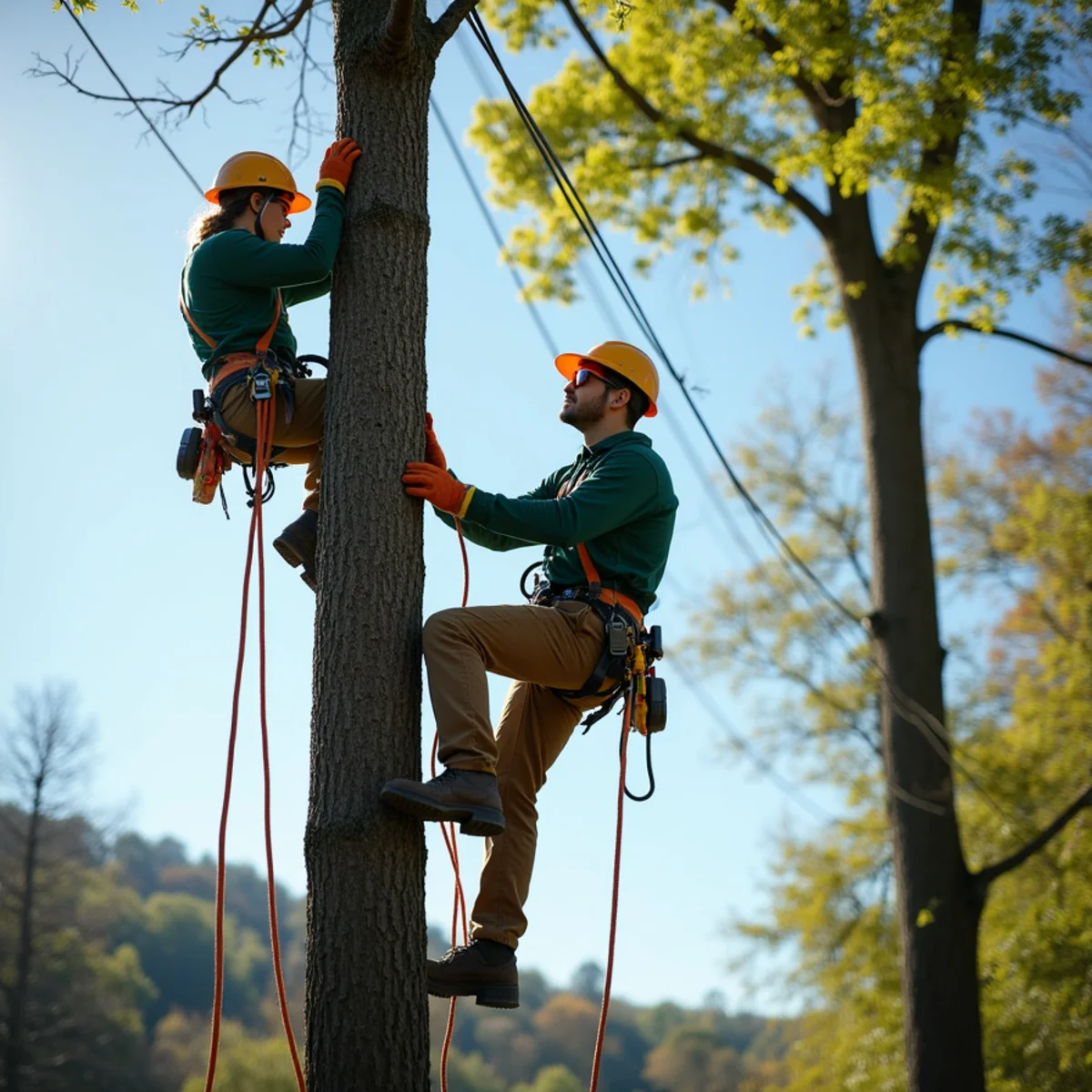
Tree on a Power Line in Morganton: Who to Call First
24/7 Emergency Dispatch
Immediate storm & hazard tree response
Serving Since 2021
NC LLC #2158995 · Fully Insured
4.4★ Google Rating
35+ verified homeowner reviews
Zero Yard Damage Rigging
Controlled rope descent · No heavy ruts
Burke County Local
Headquartered in Morganton, NC
Emergency Priority Order: When to Call 911 vs. Your Electric Utility
A tree or heavy branch falling across overhead electrical wires represents one of the most perilous emergencies a Western North Carolina homeowner can encounter. The combination of high-voltage transmission lines, volatile physical tension in green wood, and conductible ground moisture creates an immediate threat of lethal electrocution and explosive fire. Knowing the exact sequence of who to call first can save lives, prevent catastrophic residential property loss, and speed electrical grid repairs.
If you observe active electrical arcing, flashing sparks, smoke, or flames igniting branches, power poles, or roof decking, dial 911 immediately. Emergency dispatch will send the local fire department to establish a secure perimeter and immediately contact the electrical grid operator for an emergency de-energization. Do not assume the utility has automated sensors that instantly shut off the power; many downed power lines remain fully energized and capable of delivering lethal current even while laying motionless on the ground or buried under fallen tree foliage.
If there is no active fire but a tree has collapsed onto, pulled down, or is hanging precariously over overhead lines, your next call must be directly to your electric service provider. In Morganton, service territories are divided among three major entities: the City of Morganton Electric Department (which serves residents within the municipal limits), Duke Energy (which powers broad corridors across Burke, Catawba, and Caldwell counties), and Blue Ridge Energy (which serves rural and mountainous sections to the north and west). Provide the operator with your exact street address, the nearest cross street, and pole identification numbers if safely visible from a distance.
Step Potential & Touch Potential: Why the Ground Around a Downed Wire Is Deadly
The greatest hazard associated with trees on power lines is the invisible distribution of electrical voltage through surrounding soil, vegetation, and structural surfaces. Electrical current flowing from a downed or contacting conductor does not dissipate instantly into the earth; instead, it ripples outward in concentric voltage gradients through the ground—a phenomenon known as step potential.
When electricity enters wet soil, red clay, or puddle water, the voltage is highest at the point of contact and decreases with distance from the source. If a person walks normally near an energized tree or wire, their feet land in two different voltage zones. The resulting difference in electrical potential forces lethal current to travel up one leg, through the torso and heart, and down the other leg. In wet North Carolina weather, lethal step potential can extend 35 to 50 feet or more from the contact point, creating an invisible kill zone.
If you find yourself unexpectedly within an energized zone, do not run or take normal walking strides. Keep your feet firmly pressed together and shuffle your feet across the ground without lifting them, ensuring your shoes remain in continuous contact with the earth, or bunny-hop with both feet joined together until you are at least 40 feet clear. Never touch metal chain-link fences, guardrails, wet landscaping, or vehicles that are anywhere near a downed wire, as touch potential will channel current through your body to the ground with deadly efficiency.
Service Drop vs. Distribution Lines: Understanding the Utility Demarcation Point in Morganton
Homeowners are often confused about who is legally and financially responsible for removing trees on electrical wires. The answer depends entirely on the location of the line within the electrical grid hierarchy, defined by the utility demarcation point. Understanding this boundary avoids costly disputes and delays in getting power restored.
High-voltage primary and secondary distribution lines—the thick cables mounted high on utility poles along roadways, alleys, and commercial rights-of-way—are the sole property and responsibility of the utility company. Utility tree trimming contractors (such as Asplundh or Lewis Tree Service) clear trees from these high-voltage corridors to maintain grid reliability. Private arborists and homeowners are strictly prohibited by federal and state law from trimming or removing trees within these utility rights-of-way.
Conversely, the lower-voltage service drop—the insulated overhead wire running from the transformer pole directly to your home's weatherhead and electric meter—falls under a shared demarcation. While the utility owns the wire itself and will disconnect it during an emergency, the homeowner is legally responsible for maintaining tree clearance along their private service drop and for repairing any physical damage to the weatherhead, service mast, or meter base attached to the home's exterior siding. Private climbing arborists are hired by the homeowner to clear fallen trees from private service drops once the utility has de-energized the circuit.
Why Private Tree Services Cannot Touch Trees on Energized Lines (OSHA & MAD Regulations)
Homeowners experiencing power outages during a storm frequently call private tree services demanding immediate removal of limbs entangled in overhead lines. However, reputable tree companies cannot and will not touch any tree or branch in contact with electrical wires until the utility company has formally verified de-energization and grounded the circuit.
Federal OSHA standard 1910.269 and ANSI Z133 safety regulations strictly mandate Minimum Approach Distances (MAD) for tree workers who are not certified utility line-clearance arborists. For standard distribution voltages (typically 7,200 to 14,400 volts phase-to-ground in Western NC neighborhoods), uncertified workers and their conductive equipment must maintain a mandatory clearance buffer of at least 10 feet at all times.
Wood is an effective electrical conductor, especially when wet from rainfall, coated in morning dew, or composed of living sapwood with high electrolyte concentrations. If a chainsaw bar, pole saw, or climbing line touches a limb that is in contact with an energized wire hundreds of feet away, full line voltage instantly transfers through the tool directly to the climber or ground worker. For this reason, professional arborists will only mobilize once utility linemen have physically isolated the line, installed grounding clamps, and provided a clear safe-to-work signoff to protect crew members and property.

After Utility De-Energization: Controlled Arborist Dismantling with Insulated Rigging
Once the utility company has de-energized the service line or cleared the immediate high-voltage hazard, specialized private arborist teams step in to safely dismantle the remaining wood without damaging residential roofs, landscaping, or utility hardware.
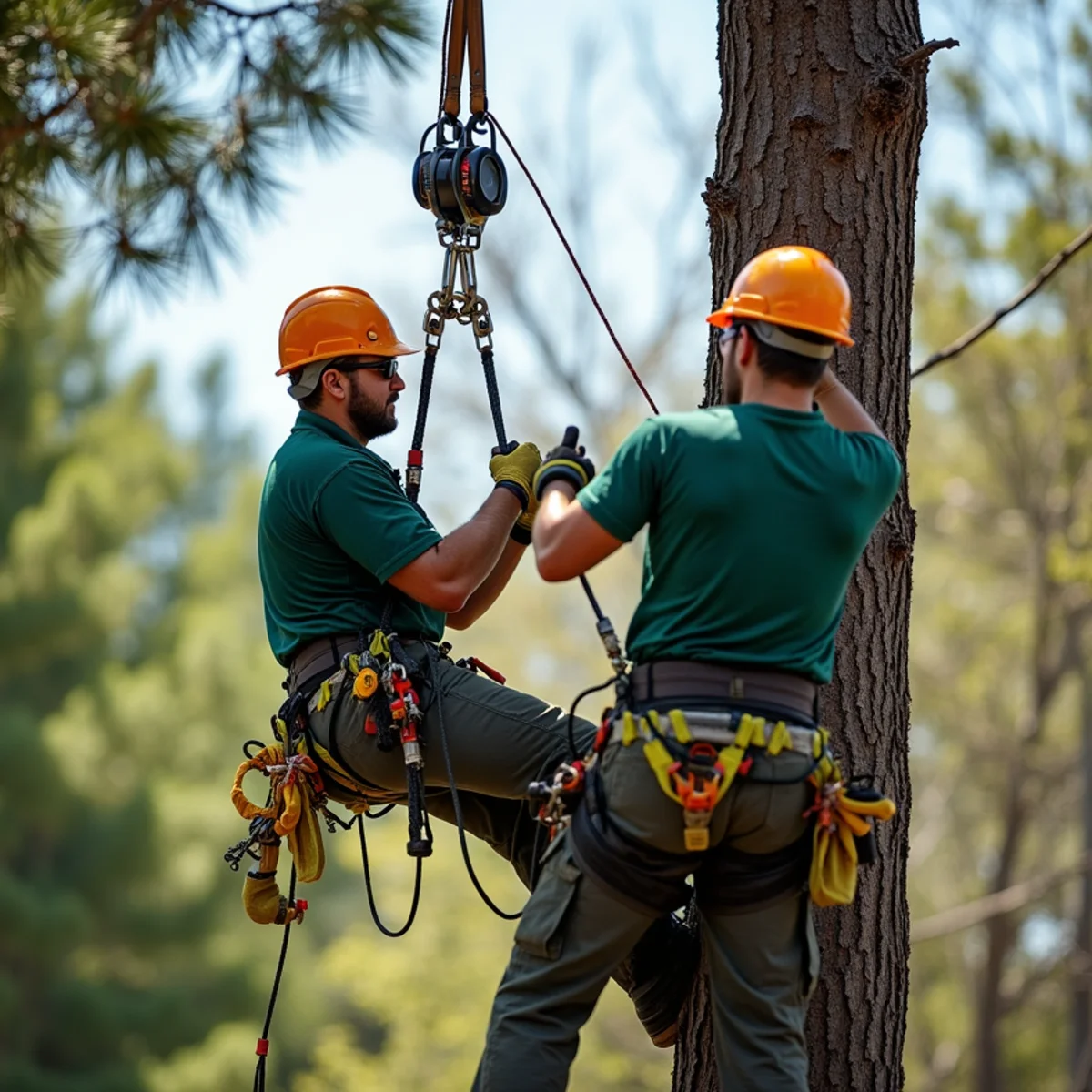
RAM Tree Service LLC (NC LLC #2158995) approaches electrical line clearance with specialized climbing protocols. Owner and lead climber Ron Martin accesses the tree using non-conductive synthetic climbing lines, positioning aloft with multi-point friction tie-ins. Even on de-energized lines, our team treats every conductor as potentially back-fed by uninspected portable residential generators running in the neighborhood. We utilize non-conductive fiberglass poles, insulated arborist handsaws, and static rigging lines to execute precise sectional takedowns.
Every branch suspended over the utility line is rigged using overhead pulleys and controlled lowering lines. Ground technician Buddy manages the descent using an anchored Port-a-wrap friction brake, easing heavy timber away from communication cables, telephone drops, and electric service masts without allowing wood to drop or bounce. By lowering limb wood into tight, pre-cleared drop zones, we eliminate property damage while preparing the electrical pathway for immediate service restoration.
Restoring Home Power: Weatherhead Repair, City/County Inspections & Final Reconnection
Clearing the fallen tree from your service drop is only one phase of regaining electrical service after a storm. If the falling tree ripped the electrical service mast or weatherhead loose from your home's exterior siding, utility linemen cannot simply re-hang the wire and restore power.
Under North Carolina building and electrical codes, the utility company is legally prohibited from reconnecting power to a damaged service entrance. The property owner must hire a licensed North Carolina electrical contractor to install a new rigid conduit service mast, weatherhead, meter base, and grounding rods. In the City of Morganton or unincorporated Burke County, the completed electrical repairs must pass a formal inspection by the municipal or county building inspections department before a green tag is issued.
Once the inspector signs off on the installation, the utility company will return to re-string the service drop from the pole to your new weatherhead, splice the connections, and re-insert the electrical meter. RAM Tree Service LLC coordinates seamlessly with local electricians and emergency services across Morganton, providing rapid tree removal and complete brush chipping so your electrical contractor has clear, safe access to rebuild your service entrance without delay. Call (213) 468-5153 for prompt assistance and rapid emergency storm tree clearing.
Recommended Arborist Services & References:

About the Author: Ron Martin, RAM Tree Service LLC
Ron Martin is the owner and lead climber at RAM Tree Service LLC in Morganton, NC. Dedicated to proper arboriculture, rigging physics, and protecting client lawns from heavy machine ruts, Ron has guided Burke County property owners through routine prunings and catastrophic post-Helene storm recoveries.
More Tree Care Guides & Advice
What to Do When a Tree Falls on Your House in Burke County
What to do when a tree falls on your house in Burke County, NC: immediate safety, utility shutoffs and insurance photos. Call (213) 468-5153 today.
Leaning Tree After Heavy Rain: When Is It an Emergency?
Is a leaning tree after heavy rain an emergency in Morganton, NC? Root plate heaving, saturated clay and hazard triage. Call (213) 468-5153 today.
Tree Removal Cost in Morganton, NC: 2026 Price Guide
Realistic tree removal costs in Morganton, NC: tree size, access, rigging factors and typical Burke County price ranges. Call (213) 468-5153 today.
Facing an Active Tree Emergency in Burke County?
Tree on your roof, power line, vehicle, or blocking a private drive? Our climbing and rigging crew is standing by 24/7 across Morganton and the foothills.
Frequently Asked Questions
Direct, transparent answers regarding tree work, rigging methods, insurance documentation, and scheduling.
The electric utility company (City of Morganton Electric, Duke Energy, or Blue Ridge Energy) will disconnect or de-energize the service line for safety, but the homeowner is responsible for paying a private tree service to remove the fallen tree from private property and clear the service corridor. The utility will only reconnect the wire once the tree is removed and any damaged home electrical equipment (mast, meter box) is repaired.
Our Morganton, NC Base of Operations
Centrally positioned on Old Hickory Tree Road in Morganton to quickly dispatch climbing crews, bucket-free rigging gear, chippers, and emergency response teams across Burke, Caldwell, McDowell, and Catawba counties.
Ready for an Honest, On-Site Tree Service Estimate?
Climbers who rope-lower limbs to protect your yard, stone walls, and roofs. Call Ron & the RAM Tree Service team directly.